
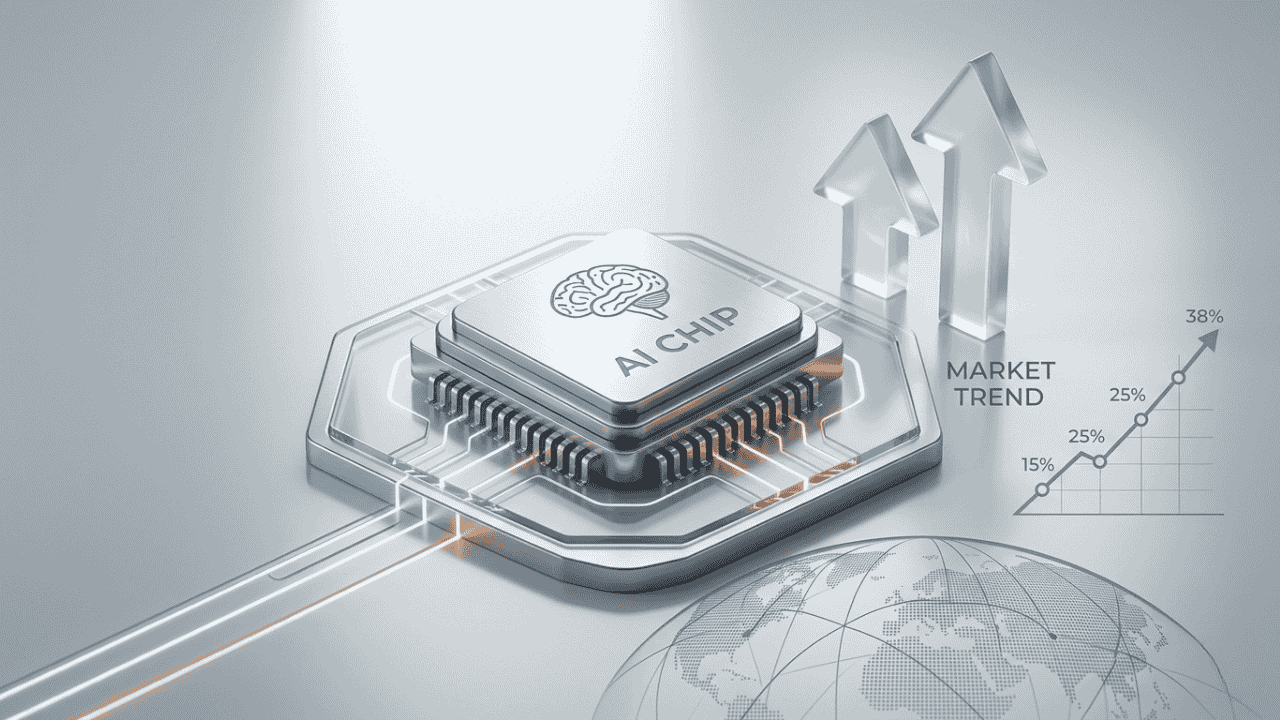
The Artificial Intelligence (AI) Chip Market is quickly becoming the backbone of modern computing. Every time you interact with a chatbot, stream personalized content, or use a smart device, there is a high chance an AI chip is doing the heavy lifting behind the scenes. What used to be a niche segment within semiconductors is now central to how companies build and scale digital products.
There is so much to pay attention to in this developing sector of the tech industry because it is so closely linked to many other significant technological trends and developments. As AI becomes more sophisticated, and thus more advanced, demand for faster, smarter and more cost-effective AI chips will continue to increase.
Why the Artificial Intelligence (AI) Chip Market Matters
Workloads in artificial intelligence (AI) will inherently be different from those in typical computing, because they require using large volumes of data and performing complex processing across many data streams simultaneously. This puts the AI chip market in a very important role in computing today.
Companies have moved away from using only CPUs, as most of them are now using GPUs, TPUs or other specific AI accelerators manufactured for machine learning and deep learning applications. They all have been designed with the specific purpose of efficiently running algorithms that fall within those parameters. In other words, we went from days to hours for tasks on traditional CPU platforms, if we execute those tasks on AI-optimized equipment We’re seeing this rapid increase in adoption because of the significant amount of performance improvement.
Expanding Beyond Data Centres
Artificial Intelligence (AI) Chip market remained mostly related to data centres until relatively recently. Even though the data centre will still be a major part of this market with large AI models’ training as the primary application, that landscape is rapidly changing. With the movement of AI to the edge of the network, AI chip manufacturers will also see a shift in how they develop their chips. The following are just a few examples of how various types of mobile devices are using AI chips:
- Smartphones now contain dedicated AI processors to complete functions such as facial recognition and voice recognition.
- Smart cameras and Internet of Things (IoT) devices rely on AI chips for real-time decision-making.
- Autonomous vehicles require onboard AI chips to process information rapidly.
Manufacturers are focusing on how to create chips that are not only high-performance but also energy-efficient and compact, because this shift towards the edge of the network will impact the design and performance of AI chips.
Custom Silicon Is Changing Competitive Dynamics
A significant development in the AI Chip Market is the rise of tailored chip manufacturing. Major technology companies don’t depend on third-party general-purpose chips any longer. Instead, many are now creating their own AI hardware that better fits with their software ecosystems and internal workloads. The advantages of this are numerous. Custom chips can be customized to provide better performance for individual AI models. They will also reduce dependency on external supply chains. Furthermore, as a result of economies of scale, custom chips will offer companies a greater long-term financial benefit.
This trend is shifting the competitive dynamics. While chipmakers continue to remain integral to the landscape, cloud providers, consumer electronics companies, and automobile manufacturers are increasingly getting involved in the development of custom chips. This is leading to a more strategic, specialized, and interconnected AI Chip Market.
Key Trends Shaping the Artificial Intelligence (AI) Chip Market
Several major trends continue to fuel momentum in the ever-evolving landscape of artificial intelligence (AI). At the forefront of these is the rapid evolution of generative artificial intelligence, including large language models, image-generation tools, and multi-modal artificial intelligence systems, which all require enormous amounts of computational resources and drive demand for higher-performance processors.
Another significant trend is the shift toward increased energy efficiency. While the growth of AI capabilities continues unabated, so too does the rise in concern over energy consumption associated with carrying out AI workloads in data centers and on computer systems that carry heavy loads of computing activity. This shift toward energy-efficient computing is driving companies to build chips that provide greater performance per watt rather than simply pursuing raw performance.
Finally, the market for artificial intelligence chips is being bolstered by the transition from experimental pilots to the incorporation of AI into every aspect of a company’s workflows, platforms, and customer-facing products. This change will directly support stronger, longer-term demand for specialized computing hardware.
Challenges the Market Still Needs to Address
The market for AI chips continues to expand, but there are significant hurdles that must be considered. One of the most prevalent is complexity in manufacturing. The manufacture of advanced chips is extremely complex due to the level of sophistication required in the fabrication processes. Very few companies can commercially manufacture AI chips at scale.
Risks from supply chain disruptions are another hurdle. Since semiconductor production relies on a global supply chain of manufacturers, disruptions in the supply chain can create bottlenecks to the availability and pricing of AI chips.
Costs are another major barrier to developing and producing AI chips. New AI chip designs require significant investments in R&D, design, testing, and manufacturing. As such, new companies (or small companies) will find it very difficult to enter this market segment, while established companies will take more risks (due to a lack of capital compared to their established competitor).
Software compatibility is also a significant issue in the AI chip market. Hardware is only as good as its supporting ecosystem (i.e., software), and developers require a complete system of software frameworks and tools to develop software that runs on multiple chip architectures. While an AI chip might be technologically superior in an absolute sense, without an appropriate supporting ecosystem, it is likely to be slow to gain acceptance even if it is the best-of-breed.
What the Market Could Look Like in the Coming Years
According to market analysts, the future of the Artificial Intelligence (AI) Chip industry is headed towards service-based markets rather than commodity-based products. This will mean that there will likely be growth in chip designs that pertain to specific types of functions (such as training, inference, automotive AI, edge AI, and industrial automation), as opposed to a single generalized function for all chips.
Another major consideration moving forward will be efficiency. Even though performance is still an important aspect of a chip’s functionality, companies now desire PC processors, which are able to run bigger models but do not incur high energy costs. This will have a significant influence on how company design strategies and investment priorities are developed. The AI chip market will also become more integrated with other emerging technologies such as 5G, edge computing, robotics, and high-performance cloud infrastructure. Therefore, the expected growth of AI chips will not develop in isolation; rather, it will directly correlate to the continued evolution of digital systems. From a company perspective, choosing hardware will become even more strategic. For consumers, they will be able to access faster, smarter, and more responsive digital experiences. For the technology industry as a whole, the AI chip market will continue to be one of the most significant areas to track.
FAQs
What is the Artificial Intelligence (AI) Chip Market?
It refers to the industry focused on designing and producing specialized chips that support AI workloads such as machine learning and deep learning.
Why is the Artificial Intelligence (AI) Chip Market growing?
The increasing use of AI across industries, along with demand for faster and more efficient processing, is driving growth.
What types of chips are used in AI?
Common types include GPUs, TPUs, ASICs, and other AI accelerators designed for specific tasks.
Where are AI chips commonly used?
They are widely used in data centres, smartphones, autonomous vehicles, healthcare systems, and IoT devices.
This is a guest post contributed by an external author. If you’re interested in submitting your own article and reaching our audience, feel free to visit our “Write for Us+ AI” page for guidelines and submission details.
 Alishba Amjad